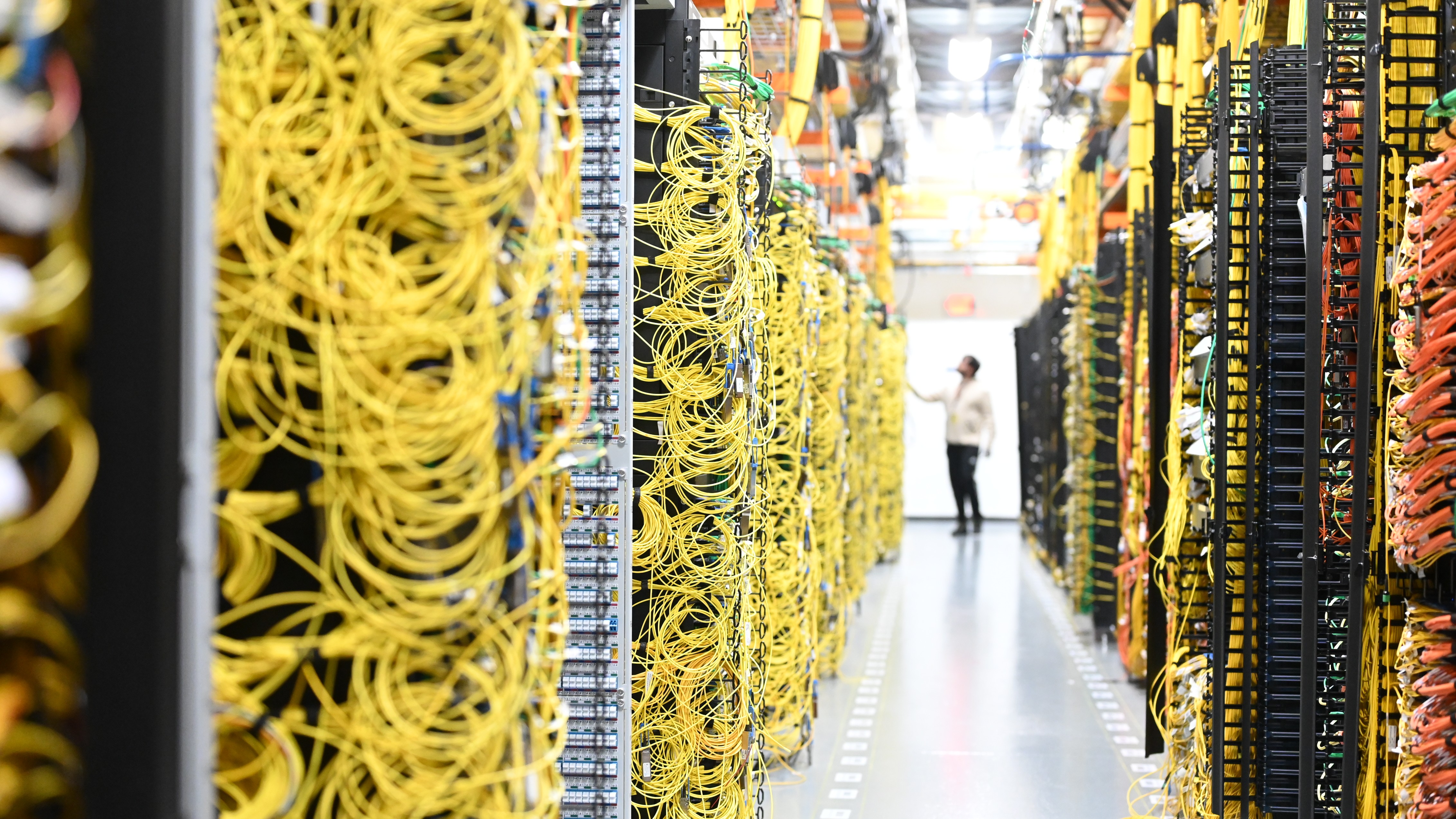

Amazon is building cloud data centres to support India’s digital aspirations responsibly, focusing on minimising our impact on the environment and communities in the country. Every data centre Amazon builds in India is designed to use less energy, avoid drinking water and give back to the communities around it. Here is how Amazon is continuously innovating to optimise the use of water and energy in our data centre operations in India.
Using no drinking water for cooling our data centres
None of Amazon’s operational data centres in India use any water for cooling as it uses air-cooled chillers. Very little potable water is used on site for basic human needs, such as restrooms and drinking water for Amazon employees. Some water may be used for landscaping or biodiversity maintenance, but we prioritise using recycled water (treated sewage water) instead of drinking water where we can.
Bringing our global expertise on water efficiency and use of recycled water to India
AWS data centres are over 7x more water-efficient than the industry average meaning they use far less water for each unit of compute. This is the result of years of investment in custom cooling technology, smarter systems, and a commitment to minimise water use wherever possible.
Globally, AWS is already pioneering the use of recycled water for data centres and we are bringing this same expertise to India. We already operate 26 data centres using recycled water around the world —more than any other cloud provider, with 130 more contracted globally.
Where we do use recycled water, we are often investing heavily into local infrastructure projects to make this possible for our operations, for example, investing in new water pipelines for recycled water.
In Mumbai and Hyderabad, most of the sewage water goes unused. Amazon plans to put this sewage water to good use and recycle it to cool some of our newest data centres in the region. This ensures we never draw on drinking water supply for cooling our data centres. Using recycled water for cooling also means less power is consumed from the grid, making more power available for other consumers in the vicinity.
Our approach of using this recycled water for cooling our data centres directly aligns with the National Framework on Safe Reuse of Treated Water and Maharashtra’s policy for promoting circular economy through reuse of urban wastewater (2025), which prioritises the use of treated sewage water for industrial and non-potable purposes, ensuring freshwater reserves are preserved for communities.
Our approach of using this recycled water for cooling our data centres directly aligns with the National Framework on Safe Reuse of Treated Water and Maharashtra’s policy for promoting circular economy through reuse of urban wastewater (2025), which prioritises the use of treated sewage water for industrial and non-potable purposes, ensuring freshwater reserves are preserved for communities.

Returning more water to communities than we consume in direct operations
While we’re constantly getting more efficient and using less water, we want to go well beyond that and actually create more usable water around the world than we consume. So we've committed to being water positive by 2030.
In India, Amazon has achieved water positivity ahead of our 2027 target, returning 120% of the water we used across our direct operations, including corporate offices, data centres and fulfilment centres, in 2025 to communities.
Amazon is investing more than ₹62 crore towards water stewardship initiatives across the country. These projects are expected to replenish more than 4 billion litres of water annually once completed, enough to meet the annual domestic water needs of approximately over 1 lakh Indians for a full year. The types of water projects include watershed restoration, lake rejuvenation, efficient irrigation, groundwater recharge, and water quality improvement initiatives tailored to local needs.
In Hyderabad, Amazon collaborated with SEARCH, a nonprofit supporting marginalized rural communities, on a water replenishment project near AWS data centre operations. The project rehabilitated ten existing water storage ponds and constructed 100 new ponds across 12 villages, delivering nearly 86 million litres annually, enough for annual domestic water consumption 560 Indian households. The ponds have increased community water availability, boosted agricultural output, and helped recharge depleted groundwater.
In Mumbai, Amazon is collaborating with ICRISAT on a ₹10 crore water restoration project spanning 1,500 hectares in Maharashtra's Vaitarna hydrobasin. The nearby Tansa and Lower Vaitarna reservoirs supply over 870 million litres of drinking water daily to Mumbai. The project will replenish 1.3 billion litres annually, enough for annual domestic water consumption for 9,000 Indian households. Expected to complete in 2027, it will also benefit 700 farming families, boosting household incomes by approximately 80% through increased Rabi season productivity.
Reducing the amount of energy we use in our data centres
Other than water, energy is the other resource we are committed to using responsibly in our operations. For many years, we've continuously innovated on improving power and energy efficiency across all aspects of our infrastructure - from the systems that power our servers, to the techniques we use to cool our data centers, to the innovative server designs we provide to our customers. We bring this same high bar on design, engineering standards, and operational efficiency to every data centre we build in India.
All these efforts have resulted inAWS infrastructure that is up to 4.1 times more energy-efficient than on-premises data centres. This is what makes cloud data centres fundamentally different: instead of thousands of companies each running their own half-empty servers, we bring everyone's work together onto shared infrastructure that runs at full capacity. That means less wasted energy for every calculation, query, and artificial intelligence task.
Avoiding the local power distribution grid that serves residents
Wherever possible in India, we draw power from our own dedicated extra high-voltage substation, planned in coordination with local utility authorities. We take utmost care to ensure that our data centres do not draw or divert power from the local distribution grid that serves residents and commercial consumers.

Powering our operations with renewable energy projects in India
For the energy we do use, we invest heavily in renewable energy projects in India, such as wind and solar energy to power our operations.
Amazon’s renewable energy portfolio in India comprises of 53 solar and wind projects nationwide. These projects are collectively capable of generating more than 4 million megawatt (MW) hours of renewable energy – enough to power the equivalent of over 1.3 million Indian homes annually. Our utility scale renewable energy investments include a 98 MW wind farm in Osmanabad, Maharashtra; a 99 MW wind project in Solapur, Maharashtra, and a 100 MW wind farm in Koppal, Karnataka.
As India’s digital economy grows, Amazon is committed to building and operating cloud infrastructure alongside it, power India’s digital future sustainably.